I want my hand back: how many repetitions arm and hand recovery really takes
Published on
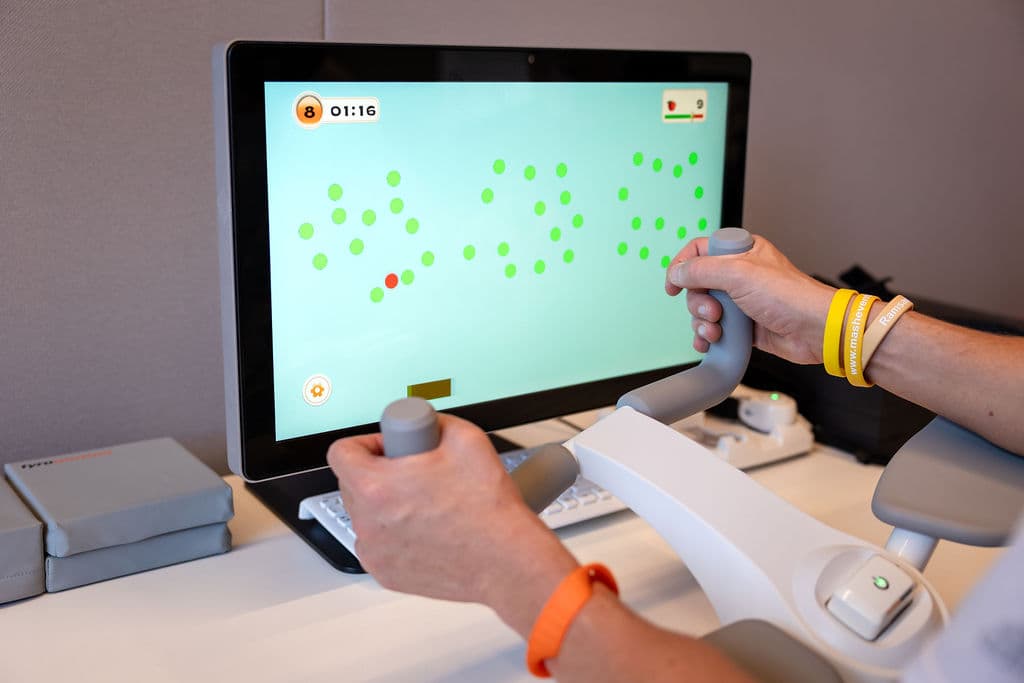
Ask people a year after a stroke what they miss most and the answer is very often the hand. The leg frequently comes back far enough to walk. The arm gets strong enough to help. The hand sits there, present and unhelpful, and every dropped fork is a reminder.
If that is where you are, the question you are probably asking is whether more therapy would change anything, or whether you have had your share. There is a useful answer to that, and it has a number in it.
Why the hand is usually the last thing to come back
Walking is forgiving. A leg that works at seventy per cent still gets you across a room, perhaps with a stick, perhaps slowly. The movement is large, repetitive and mostly symmetrical, and your nervous system has a lot of backup for it.
A hand at seventy per cent does almost nothing you want it to do. Buttoning a shirt needs the thumb and two fingers to move independently, in sequence, with the right amount of force and without the others joining in. That level of separate finger control depends on pathways that are harder to rebuild than the ones used for stepping.
So the hand is not slow because you are failing at it. It is slow because the standard for a hand being useful is far higher than the standard for a leg being useful.
The number nobody mentions in the hospital
Research on how the motor system reorganises points towards several hundred purposeful movements in a training session before meaningful change is driven. Not a few dozen. Several hundred.
Now compare that with what a session often contains. When researchers have sat in on upper-limb therapy and counted, the totals have come out low and wildly inconsistent. Older studies counted around thirty movements of the affected arm in a session. More recent audits found more, sometimes into the low hundreds, but with enormous variation between one therapist and the next.
Two people can both be told they had an hour of arm therapy and differ twentyfold in what their nervous system actually received. That is the gap that decides a great deal, and nobody mentions it, because the timetable records the hour and not the count.
What this means about robots, honestly
Robotic arm and hand devices are often sold as being better than a therapist. The trial evidence does not really say that. When robot-assisted therapy is compared against conventional therapy delivered at the same high intensity, outcomes tend to come out similar.
That result gets reported as robots not working. Read it the other way round and it is the most useful finding in the field: the dose is doing the work. The machine is not magic, it is simply the only practical way to reach several hundred or a thousand repetitions in a session, every session, without a therapist physically moving your arm for you three hundred times.
Measured robotic sessions have reached around a thousand movements. That is the point of the equipment, and it is why we write about why intensity determines therapy outcomes rather than about brand names. Our overview of the devices used for arm and hand work explains what each one is for.
Counting, instead of timing, between sessions
Most home programmes are written in minutes. Try writing yours in repetitions instead, because minutes can be filled with very little.
Choose a movement that sits right at the edge of possible for you, then do it in sets with a number attached. Ten, rest, ten again. Watching a weekly total climb is also better for morale than trying to detect improvement day to day, which you cannot.
If a movement is impossible on its own, an attempt assisted by your other hand still counts. Your therapist can tell you which movements are worth counting and which are only building habits you will later have to undo.
When the hand tightens up instead of opening
A hand that stiffens when you concentrate, or when you are tired or stressed, is a very common experience after a stroke. It is discouraging, and it leads a lot of people to use the arm less, which makes things worse rather than better.
Usually it means the task is too hard for the current stage rather than that you should stop. An easier version of the same movement, done more times, tends to be more productive than a hard version done a few times badly.
Where the stiffness is severe enough to need medical treatment, that decision belongs with your treating physician, who can talk you through the options.
Where this leaves you
Nobody can tell you in advance how much of your hand will come back. Anyone who offers you that number is guessing. What can be established is where you are now, measured properly, and whether the amount of practice you are currently getting is anywhere near the amount the evidence suggests is needed.
That is what a free initial assessment at Nextherapy is for. It takes place in Zurich or St. Gallen, and you will leave it knowing your starting numbers and what a realistic training plan would look like. Therapy is covered by Swiss insurance under the usual conditions, and we do not charge extra for the technology.
The next step
Talk to us about your situation.
In a free pre-assessment we discuss your medical history, your goals, and your insurance coverage options.
Book a consultation →