Lokomat therapy explained: how robotic gait training accelerates recovery
Published on
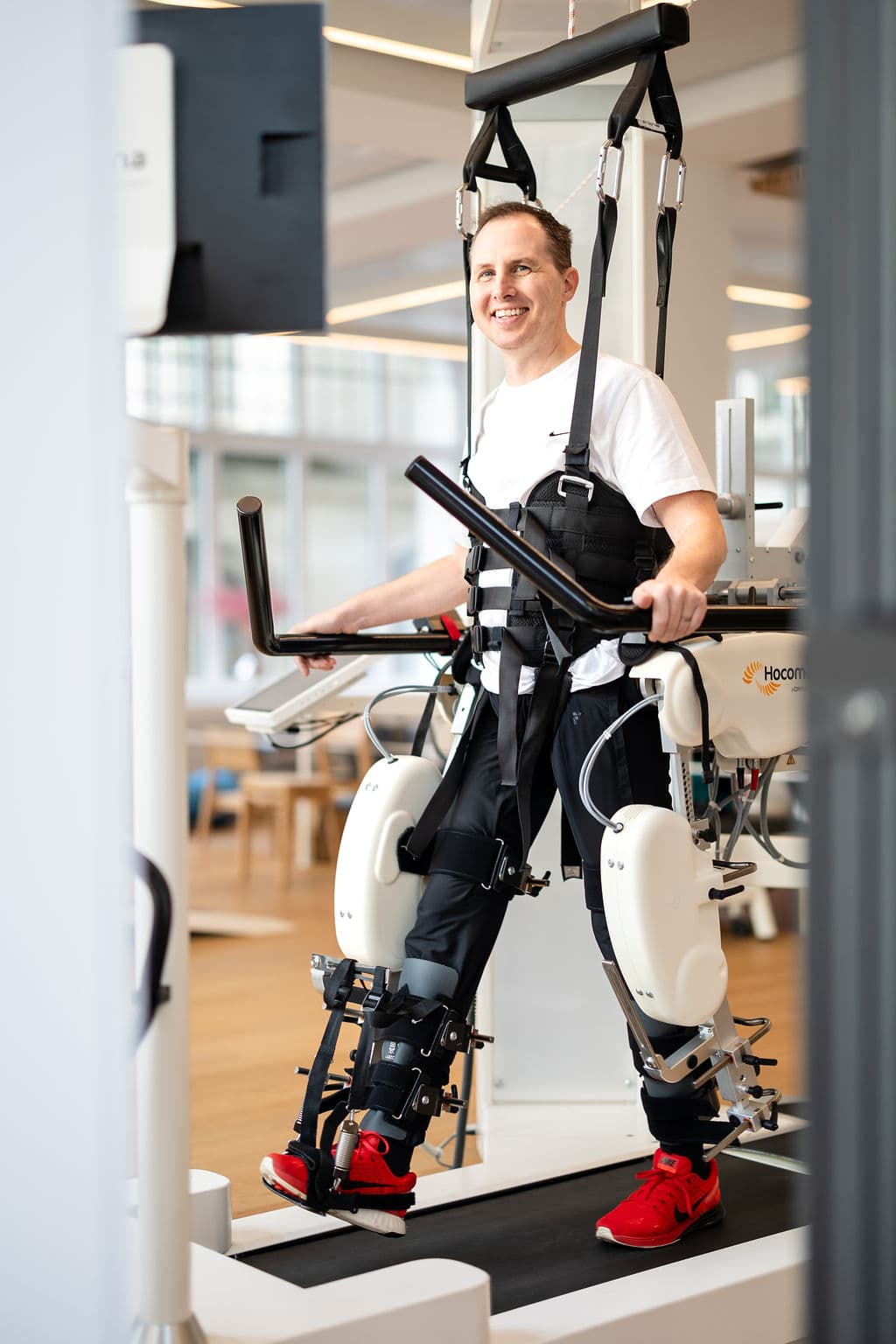
Being able to walk again is one of the most important goals in neurological rehabilitation. The Lokomat is one of the most extensively studied robotic gait training systems in the world and a central component of our therapy in Zürich.
What is the Lokomat?
The Lokomat is a robotic gait trainer developed in Switzerland, born out of research at ETH Zürich and Balgrist University Hospital. It combines a treadmill with a body-weight support system and robotic leg orthoses that guide the patient’s legs through a physiologically correct gait pattern.
The system continuously measures how much force the patient contributes and adjusts its support in real time: as much help as necessary, as little as possible. A screen with game-like exercises provides immediate feedback and keeps motivation high, which makes a particularly large difference for children.
Why repetition is decisive
After damage to the brain or spinal cord, the nervous system learns through repetition: the more often a correct movement pattern is performed, the stronger the neural connections become. Specialists call this neuroplasticity.
This is precisely where robotics is strongest: a single Lokomat session allows more than a thousand guided steps, many times what is achievable in conventional one-on-one therapy. Studies and international guidelines support robotic gait training, particularly after stroke and in spinal cord injury, as a complement to conventional therapy.
Who is the training suitable for?
Robotic gait training is used across many neurological conditions: after stroke, in spinal cord injury, multiple sclerosis, Parkinson’s disease, and acquired brain injury.
For children, Nextherapy offers the paediatric Lokomat Pro. Specially designed paediatric leg orthoses fit smaller legs, the dynamic body-weight support is finely tuned to the child, and child-friendly, game-based feedback on the screen turns training into a motivating game. The level of support can be adjusted precisely to the child’s abilities, and every session is recorded so that progress becomes visible to parents and therapists. Training is typically possible from around two and a half years of age, for example in cerebral palsy. Whether it is appropriate in an individual case is determined by our therapists in a careful initial assessment.
What does a session look like?
At the start, your therapist fits the orthoses and adjusts the body-weight support individually. Training on the treadmill then begins, guided and controlled by the therapist, who continuously adjusts parameters such as speed, support, and unloading. Training data is recorded at every session, making progress measurable and allowing therapy to be steered based on data.
The Lokomat is never the whole therapy: it is embedded in an individual programme of physiotherapy, occupational therapy, and further technologies, aligned with your personal goals.
What does it cost?
At Nextherapy, Lokomat training, like all of our robot-assisted therapy, is billed at the regular robotics tariffs through health, disability, accident, or military insurance, with no extra charge for you as a patient. You can read more in our article on insurance coverage.
Talk to us about your situation.
In a free assessment we discuss your medical history, your goals, and your insurance coverage options.